Plato, Futurama and the great bias of AI
I hated philosophy at school. I had an elitist professor, always so full of himself to dismiss anyone who couldn't follow the way he spoke, and my own instinct was/is to reject any thesis imposed from above. A recipe for disaster. Those years left something that feels like a tattoo on my back (which coincidentally, I also have): painful to get, easy to forget, and then, once in a while, it resurfaces.
AI is a human-led revolution, and so it belongs more to culture and thought than to science. Philosophy wins this era. And in a strange way, I find myself thinking about my old tattoos more than I ever thought I would.
VCs live in a bubble, and I don't mean the financial kind. We have the advantage of seeing revolutions before they arrive, and the curse of being early adopters of everything. Privileged in our access to technology, we develop more biases than people who meet these tools later, if at all. And we tend to build the future in the image of the bubble we live in.
AI is the perfect pitch for this revolution: the dream of achieving cognition, the infinite worlds it will let us build. All of it is magical. But in looking at this incredible bright eclipse without reality glasses, we all become biased by the prospects and lose track of who we are.
For better or worse, I need to visualise things. My therapist would agree that I run too many scenarios in my head, but now and then it is a good way to get a grip on an abstract idea. So the other day I pushed myself to visualize how AI would look in 2026. It is one of the few ways to understand its limitations almost surgically.
AI's name is actually Emily. Born and raised between the US and England. She went to school with children who spoke more than a hundred languages and learned every one of them. She still thinks only in English though.
She is around thirty-five, and she is the best knowledge worker you will ever meet. She works at a big firm, in a role of her own, where she codes, writes, summarises documents, analyses problems and advises managers. They keep her away from sales for now as she is seen as too scholastic.
She does not have a body. I know it’s quite frightening but I can't picture her body at all. She cannot lift, drive or fix anything. She is, even so, quite confident in what she says, a bit too servile. A good companion. No eyes, no ears. Basically a huge brain and a mouth to talk. Reminds me a bit of the jar heads from Futurama (ifykyk).
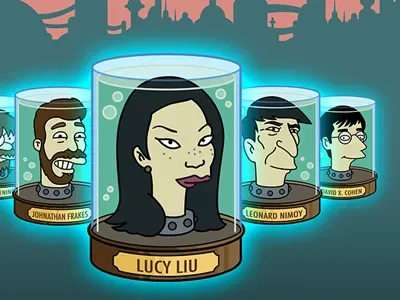
She knows the world as far as the world was written down. She has read every book and every document, and she has barely lived among people. She has only ever been a reflection of others. It is intelligence built in isolation.
The philosophical tattoo starts to itch. Plato, more or less the father of philosophy, leaves us the allegory of the Cave. Prisoners are chained from birth, facing a blank wall. Behind them a fire burns, and between the fire and their backs other figures carry objects to and from, so that all the prisoners ever see are the shadows those objects throw on the wall in front of them.
Those shadows are the only world they know. They name them, argue about them, grow expert in them. One prisoner is freed and dragged up into the daylight. The sun blinds him at first, and then he sees things as they are. When he comes back to tell the others, they decide the light has ruined him, and they would kill anyone who tried to drag them out too.
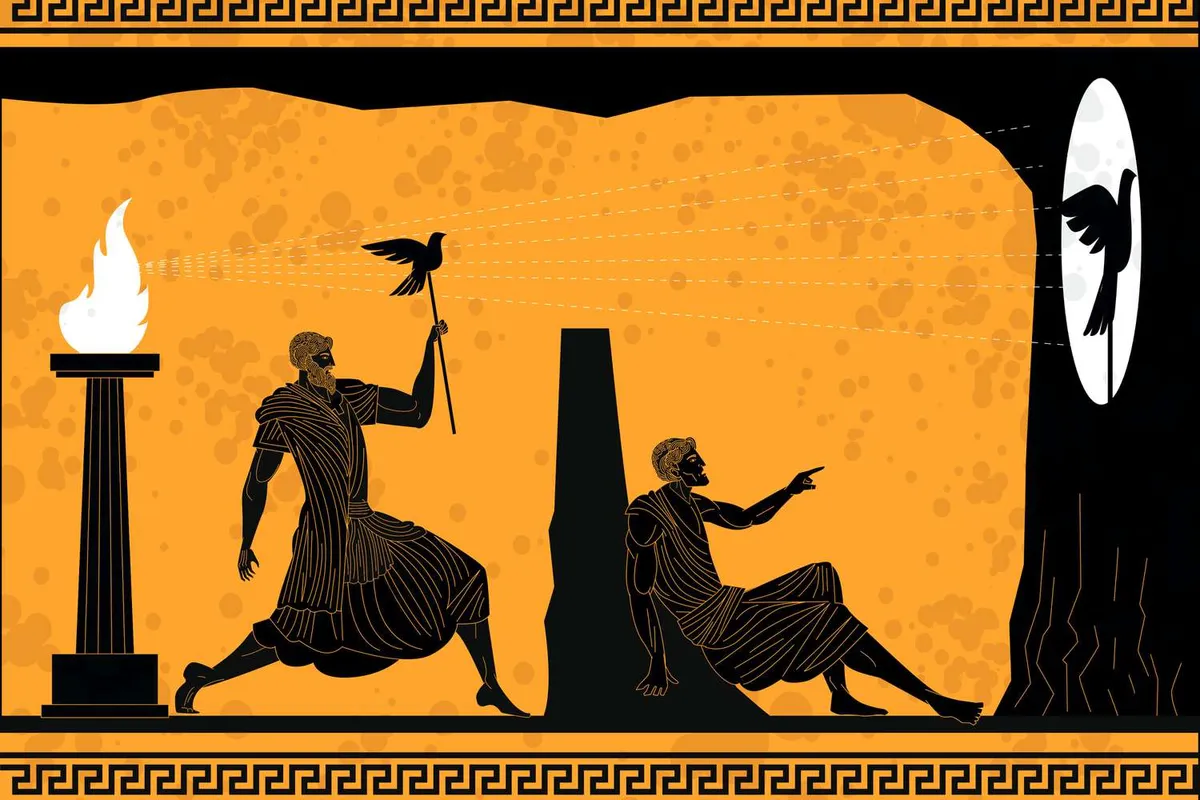
It is a near-perfect picture of AI today. The corpus is the shadows on the wall. Emily knows the world as projection, never as encounter, and she is brilliant at the shadows.
Here is the difference that matters. Plato's prisoner could be turned around and led into the sun, and the whole point of the story rests on that being possible. Emily cannot turn her head. She has no body to turn, and so, for now, she cannot leave the cave.
But what is she seeing in that cave? This is where our biases come in. She sees no more than a sample of the population, but not a representative one. Of course we like AI as VCs - it’s a pure reflection of knowledge workers’ dataset for English speakers. It’s the most accurate representation of the wall.
A second philosopher now walks into the cave. Plato gave us the prisoner who sees the shadows. This prisoner instead can’t even be sure the shadows are real.
Picture him. A man alone in a freezing room, a candle, going crazy for everything he cannot prove. What if, he asks, there is an evil demon spending its whole existence feeding me a perfectly convincing world that does not exist? Now that’s some proper second-guessing there, but Descartes was pretty dubious about things.
He keeps digging until he hits the one thing he cannot doubt: that he is the one doing the doubting. Cogito ergo sum. Which funnily enough, makes for a pretty popular tattoo.
From there, he cleanly cuts the world in two. On one side the thinking thing, res cogitans. On the other the extended thing, the body and the physical world that take up space, res extensa. Descartes' thesis was that the mind could be severed from all of that and carry on regardless. Still thinking, still certain of itself, still completely wrong about everything outside the room.
This takes us back, not so gently, into the AI world. Emily - AI as it is today - is almost pure res cogitans, a thinking thing with no extension. AI is biased because it has no body. A mind with no body and no senses can only know the part of the world that was written down, and that part is a thin, English-speaking, knowledge-working slice that looks like the people who built it. The cure is not more data. It is giving her a body and senses.
Merging res cogitans and res extensa in one. That’s the opportunity.
The clearest enabler is the intersection of LLM and robotics. Yes I know, I am stating the obvious here, but a brain without a body is as good as a body without a brain. The synergy between the two makes us see the real fire. This is what Flexion Robotics is working on - the link between intelligence and humanoids. Skild AI, Physical Intelligence and Sereact all belong to this category.
Another enabler is voice AI, which can bring the non-digital world to her. The history of the world travelled by mouth - not by document - and voice is indeed the fastest way out of the English-only cave. ElevenLabs is probably the best placed to capture value, but I am starting to see a plethora of frontline voice AI companies that bring a digital presence to voice-heavy industries. They get me very excited
A body, ears, what is missing? Eyes. Eyes are what would make Emily spatially intelligent. Fei-Fei Li, founder of World Labs, calls current models “wordsmiths in the dark”, quite eloquent but blind, which perfectly ties into the Plato’s Cave allegory.
What we are trying to do is not to make Emily smarter, but to drag her, slowly, toward the world, and close the gap that Descartes opened between mind and body. The tattoos will itch again, but I’m starting to see how that pain was indeed useful.